Total Pageviews

Monday, 8 October 2012

ASI faces uphill battle over Jain temple


 Kundalpur, Damoh, Mon Oct 08 2012, 03:26 hrs
FP
Source;Indian Express
Six years ago, defying the Archaeological Survey of India (ASI), members of the Jain community shifted an ancient idol from a protected monument atop a picturesque hill here to a new location, less than 100 metres away, where they plan to build a grand temple.
Arguing that the old structure could collapse and damage the idol of Lord Adinath, thousands of Jains blocked the roads leading to the hill as the relocation was carried out in January 2006.
In fact, the Sri Digambar Jain Atishay Kshestra Kundalpur Public Trust, which manages a group of 63 temples spread over nearly 200 acres on the hill, about 300 kms from Bhopal, had started construction of the new temple in 1997 itself.
Claiming ownership of the protected site, the ASI asked the state government to stop the construction work, but there was no response.
Now, the Jains, who enjoy significant political clout, have got legal backing, with the Madhya Pradesh High Court recently rejecting the ASI’s ownership claim. While the community is quietly celebrating the court order, calling it as much a victory of faith as facts, the ASI is set to move the Supreme Court.
The court told the trust to seek the state government’s permission for further construction work on the new temple. If permission is not granted, the trust will have to restore construction as it stood on May 20, 2006.
But the trust is not worried because the state government has always been on its side. Even as the case was going on in Jabalpur, the principal bench of the High Court, hundreds of artisans from Rajasthan were quietly working on expensive marbles and sandstones, making slabs that will eventually fit into the grand temple.
Earlier, an exquisitely designed dome was constructed over the idol, after the trust won an interim order in its favour as it argued that the idol was without a roof and needed to be protected.
“We had no support from the administration,’’ said ASI counsel K N Pethia.
Cabinet Minister Jayant Malaiya, who belongs to the Jain community, is the legislator from Damoh.
The chairman of the construction committee, Viresh Seth, said the proposed temple will be the biggest in the country and the entire project will cost around Rs 500 crore, more than double the amount the trust had in mind in 2006. Copper, silver and gold will be generously used in place of iron.
To be built in Nagar style of architecture, the temple will have a sanctum sanctorum, gudh mandap, nritya mandap, a 90-feet man stambh and a huge entrance door. The main temple will be encircled by a water body.
Incidentally, besides the ASI, which had made the MP government and its various departments respondents in the petition, a section of the Jain community was also opposed to the Kundalpur trust.
Jaipur-based Jain Sanskriti Raksha Manch had expressed concern over the trust’s restoration work saying the sanctity of the old shrine and the deity had been violated.

Sunday, 7 October 2012


55cr expansion plan for museum

M
MUMBAI: The BMC, along with the trust that maintains the Bhau Daji Lad museum, has charted out a Rs 55-crore expansion plan for the museum. Amenities on the lines of international museums like the one in Singapore will now be provided at the museum.
The highlight of the expansion plan is the construction of an exhibition area, souvenir shops, heritage conservation laboratory and seminar halls in the area behind the museum, which currently features some dilapidated structures.

The central government will contribute Rs 5 crore towards the expansion plans, while the civic body and the Indian National Trust for Art and Cultural Heritage (INTACH), which runs and maintains the museum, will contribute Rs 25 crore each.

A decision to this effect was taken on Wednesday in a joint meeting held by civic chief Sitaram Kunte, mayor Sunil Prabhu and standing committee chairman Rahul Shewale and INTACH officials. The new construction will add 50,000 sq ft to the existing building. The museum hosts at least 1.5 lakh visitors every year, of which 10% are foreigners.

"The budgetary provision for the project will be done in next year's budget and the expansion will be completed by 2015 Consultants will be appointed to prepare models for the new structure and the one who submits the best model in terms of design and architecture will be awarded the contract," said Shewale. He said that the budgetary provision for the project will be done in next year's budget and the project will be completed by 2015.

The Bhau Daji Lad Musuem, which is Mumbai's oldest museum, hosts at least 1.5 lakh visitors every year, of which 10% are foreigners. had been renovated between 2003 and 2007. Built in 1872 as the Victoria and Albert showcase, the museum is symbolic of Mumbai's growing importance as a trading hub

Saturday, 6 October 2012

Climate change mitigation & its importance for professionals


CA Rajkumar S. Adukia
The Threat to the environment, posed by the global climate change is real. Human activities are increasing the atmospheric concentrations of greenhouse gases. All theoretical models predict that these increases in greenhouse gas concentrations will cause changes in climate, both regionally and globally — with adverse consequences likely for human health, as well as to ecological and socio­economic systems.
Carbon dioxide, the most important greenhouse gas produced by combustion of fuels, has become a cause of global panic as its concentration in the Earth’s atmosphere has been rising alarmingly. This devil, however, is now turning into a product that helps people, countries, consultants, traders, corporations and even farmers earn billions of rupees while in turn benefiting the environment. This was an unimaginable trading opportunity not more than a decade ago. Carbon credits can form a massive source of revenue for the developing world.
Over a decade ago, most countries joined an international treaty to address the danger of global climate change. The United Nations Framework Convention on Climate Change (UNFCCC) is an international environmental treaty that sets general goals and rules for confronting climate change. The UNFCCC provides the basis for concerted international action to mitigate climate change and to adapt to its impacts. Its provisions are far-sighted, innovative and firmly embedded in the concept of sustainable development.
With 195 Parties, the United Nations Framework Convention on Climate Change (UNFCCC) has near universal membership and is the parent treaty of the 1997 Kyoto Protocol. The Kyoto Protocol, an addition to the UNFCCC treaty, has been ratified by 193 of the UNFCCC Parties. Under the Protocol, 37 States, consisting of highly industrialized countries and countries undergoing the process of transition to a market economy, have legally binding emission limitation and reduction commitments.
The ultimate objective of both treaties is to stabilize greenhouse gas concentrations in the atmosphere at a level that will prevent dangerous human interference with the climate system.
The clean development mechanism (CDM) allows emission-reduction projects in developing countries to earn certified emission reductions (CERs), each equivalent to one tonne of CO2. CERs can be traded and sold, and used by industrialized countries to meet a part of their emission reduction targets under the Kyoto Protocol. With more than 4,500 registered projects in 75 developing countries, the CDM has proven to be a powerful mechanism to deliver finance for emission-reduction projects and contribute to sustainable development.
The greenhouse emission reduction credit or “carbon credit” market has become a multi-billion dollar industry for credits issued under the Kyoto Protocol internationally. India is being heralded as the next carbon credit destination of the world. On 7th September 2012, the one billionth CER credit under the Kyoto Protocol’s Clean Development Mechanism (CDM) was issued to a project at a manufacturing plant in India that has switched its fuel source from coal and oil to locally gathered biomass.
LEGISLATIONS REGULATING CARBON CREDITS MECHANISM
The UNFCCC was adopted at the United Nations Headquarters, New York on the 9 May 1992. In accordance with Article 20, it was open for signature at Rio de Janeiro from 4 to 14 June 1992, and thereafter at the United Nations Headquarters, New York, from 20 June 1992 to 19 June 1993.
Pursuant to Article 22, the Convention is subject to ratification, acceptance, approval or accession by States and by regional economic integration organizations. States and regional economic integration organizations that have not signed the Convention may accede to it at any time.
The Convention entered into force on 21 March 1994. Currently, there are 195 Parties (194 States and 1 regional economic integration organization) to the United Nations Framework Convention on Climate Change.
The Kyoto Protocol is an international and legally binding agreement to reduce greenhouse gas emissions worldwide and is an addition to the UNFCCC treaty.
The Protocol to the United Nations Framework Convention on Climate Change (UNFCCC) was adopted at the third session of the Conference of the Parties (COP 3) in Kyoto, Japan, on 11 December 1997. In accordance with Article 24, it was open for signature from 16 March 1998 to 15 March 1999 at United Nations Headquarters, New York. Pursuant to Article 22, the Protocol is subject to ratification, acceptance, approval or accession by Parties to the UNFCCC. Parties to the UNFCCC that have not signed the Protocol may accede to it at any time.
The Protocol entered into force on 16 February 2005 and currently, there are 193 Parties to the Kyoto Protocol to the UNFCCC.
India signed UNFCCC on 10th June 1992 and ratified it on 1st November 1993. India acceded to the Kyoto Protocol on 26th August 2002. Under the UNFCCC, developing countries such as India do not have  binding GHG mitigation commitments in recognition of their small contribution to the greenhouse problem as well as low financial and technical capacities.
The Ministry of Environment and Forests, Government of India, is the nodal agency for climate change issues in India.
OPPORTUNITIES FOR PROFESSIONALS AND BUSINESS IN THE CLIMATE CHANGE INDUSTRY
In today’s increasingly challenging and volatile macro world, the role of the Chief Executive Officers (CEO’s) and Chief Financial Officers (CFO’s) of their companies has also evolved significantly. Their roles have expanded and evolved as strategic partners and advisors. The Key Personnel of an organization perform four main functions of Steering, Operating, Motivating and Planning, – they are in the best position to guide their organizations in shifting their business models towards adherence with the climate change agenda.
Organizations also stand to gain from environment protection and sustainable development. New business can be started as green businesses. Credits can be earned under the Clean Development Mechanism of the United Nations Framework Convention on Climate Change, thereby benefiting the Organisation and the Environment as a whole.
Professional Opportunities in the Climate Change industry include:
1. Conceptualizing the Clean Development Mechanism (CDM) project
2. Quantification of greenhouse gases (GHG) Carbon Footprint
3. Selection of Cleaner technologies for New projects
4. Project risk analysis
5. Registration of project – both national and international level
6. Obtaining Host country approval
7. Preparation of Project Concept Note
8. Preparation of Project Design Document
9. Selection of Methodologies and Baseline
10. Legal and regulatory advice during negotiations with host country Designated National Authority (DNA)
11. Advice on the appointment of independent validators
12. Assistance to achieve registration of the project by the CDM Executive Board
13. Assistance in getting verification done by Designated Operational Entity (DOE)
14. Ensure Compliances
15. Assisting various Ministries associated with National Action Plan on Climate Change (NAPCC)
16. Carbon Finance
17. Energy Audit under The Energy Conservation Act 2001
18. Advise on investment in carbon credit
19. Accounting advisory services
20. Taxation advisory services
Professional Opportunities in Environmental Laws and Green Sectors:
1. Professionals as consultants can obtain consents for establishment of a Unit under the Water (Prevention and Control of Pollution) Act, 1974 and Air (Prevention and Control of Pollution) Act, 1981.
2. Before establishing an industrial unit a certificate from a professional about proposed Capital Investment or Gross capital investment (Land, building, plant and machinery) is required to be submitted along with the consent application for establishment of a Unit. This certificate is also known as Gross Block investment certificate. This certificate should include the cost of land, building, plant and machinery without depreciation.
3. Professionals as environment consultants can play an important role in obtaining environmental clearance under the Environment Impact Assessment Notification. The environmental consultant should be conversant with the existing legal and procedural requirements of obtaining environmental clearance for a proposed project. The consultant should guide the project proponent (i.e the person who is going to establish an industrial unit) through initial screening of the project and establish whether Environment Impact Assessment (EIA) studies are required to be conducted and if so finalise the scope of such study. The consultant should also be fully equipped with required instruments and infrastructure for conducting EIA studies. The environmental consultant is responsible for supplying all the environment-related information required by the State Pollution Control Board (SPCB) and Impact Assessment Agency (IAA) through the project proponent. The consultant is also required to justify the findings in the Environment Impact Assessment and Environmental Management Plan (EMP) during the meeting with the expert groups at IAA.
4. Professionals can also assist the Industrial Units in record keeping of various hazardous wastes, chemicals etc, as prescribed under the Hazardous Wastes (Management and Handling) Rules, 1989 and Manufacture, Storage, and Import of Hazardous Chemicals Rules, 1989.
5. Professionals can also provide information on the capital and recurring (O&M) expenditure on various aspects of environment protection such as effluent, emission, hazardous wastes, solid wastes, tree-plantation, monitoring, data acquisition etc. This is important information to be given in the application for consent to establish/operate/renewal of consent.
6. Status of compliance of Rules 5, 7, 10,11,12,13 and 18 under the Manufacture, Storage, and Import of Hazardous Chemicals Rules, 1989 need to be given in the application for consent to establish/operate/renewal of consent. This status of compliance can be given by a professional in the form of a certificate of compliance.
a. Rule 5- Notification of major accident
b. Rule 7- Notification of sites
c. Rule 10 – Preparation and submission of safety report
d. Rule 11 – Updation of safety report
e. Rule 12- Requirements of further information to given to the authority
f. Rule 13 – Preparation of on-site emergency plan by the occupier g. Rule 18-Import of hazardous chemicals
7. After consent to establish/operate is obtained under the Water (Prevention and Control of Pollution) Act, 1974 and Air (Prevention and Control of Pollution) Act, 1981, professionals can ensure on a monthly/quarterly/half-yearly basis that the conditions of the consent order are complied with by the industrial unit.
8. In the same manner professionals can also ensure on a monthly/quarterly/half-yearly basis that the conditions of the authorization are complied by the industrial units under the Hazardous Wastes (Management and Handling) Rules, 1989.
9. Professionals can give a report or certificate with regard to capital investment under the Biomedical waste (Management and Handling) Rules, 1998. This is an important document to be submitted along with the application for authorization.
10. Professionals as environmental consultants can give opinion on – viability of various projects, technologies to prevent pollution and clean up polluted resources.
11. Environmental audits can be conducted by Professionals. Environmental auditing refers to the monitoring of environmental management system of the Unit, checking the status of consent orders, compliance of consent orders, water cess, other legal requirements, industrial data collection regarding product process, electric consumption, water consumption, raw materials and energy balance etc

sighting of a snow leopard in Uttarakhand is a good sign


Predators in the snow

The recent sighting of a snow leopard in Uttarakhand is a good sign. But it also underlines the urgent need to protect the habitat of this endangered animal

Shishir Prashant / New Delhi Oct 06, 2012, 00:08 IST
Source: Business Standard


As now leopard (Panthera uncia), the elusive large cat which lives in the snow-bound ranges of the upper Himalayas, has finally been sighted in Uttarakhand. A specimen of this endangered species was caught on a camera trap for the first time on April 10, 2011, and again in June this year. (A “camera trap” is a camera placed in the wild, especially in areas that wild animals are known to frequent. These are activated by light or motion and are now widely used in animal census.)

The snow leopard, known for its beautiful greyish-black fur, is a solitary animal but is occasionally found in family groups. It breeds in winter and cubs (two to three) are born after a gestation of 90-100 days. Snow leopards are a highly endangered species, their numbers steadily depleting as a result of poaching fuelled by the international demand for their fur and bones, and retaliatory killings by farmers who fear the predators will kill their livestock. The fall in the population of their prey — herbivores such as the Himalayan blue sheep (or bharal, as they are known in these parts), musk deer (kasturi mrig) and Himalayan tahr (thar) — owing to competition for food from livestock, is another factor affecting snow leopards, experts say.

The carnivorous animals are found all over central Asia, from Mongolia to China, across the Hindu Kush mountains in the north-west to Sikkim in the south-east, covering an area spanning over two million square kilometres. There are between 4,500 and 6,000 of the big cats left in the wild today. In India, the snow leopard population is estimated to be around 500. In Uttarakhand, the “him bagh” or “tharuwa”, as it is called, is thought to live at altitudes over 3,000 metres. Its presence has been confirmed in Protected Areas such as the Nanda Devi, Valley of Flowers, Gangotri and Govind National Parks, Kedarnath Wildlife Sanctuary and the buffer zones of Nanda Devi Biosphere Reserve.

“For the scientific community, it was a great moment,” says S Sathyakumar, a scientist at the Wildlife Institute of India (WII). “In the past few years, we were afraid that the snow leopard had vanished from Uttarakhand. But now, we know that snow leopards are present in the snowy wilderness of the high altitude regions of Uttarakhand,” he adds. WII is working with the state forest department officials to conduct research on the snow leopard. It was a joint WII-state forest department team that captured the first camera-trap images of the snow leopard at Malari in Nanda Devi Biosphere Reserve.

“The conservation of the snow leopard is globally significant, and so it was great achievement,” says Dr V B Mathur, the dean of WII.

Snow leopard is the apex predator in the Himalayan ecosystem and its conservation will help the entire eco-system of the upper Himalayas. The principal prey of the animals are the wild sheep and goat found in these regions, but it also hunts small mammals such as marmot (locally called pheya), pika (runda) and the Galliformes or heavy, terrestrial birds like snowcock, monal and snow partridge. It is also an opportunistic predator which sneaks up on domestic livestock such as goat and sheep grazing on the high-altitude pastures during summer, and this is what brings it into conflict with humans.

The Indian government initiated its first Project Snow Leopard in 1989, but it never took off. It started a second project in 2006 on the lines of Project Tiger in the five Himalayan states of Jammu & Kashmir, Himachal Pradesh, Uttarakhand, Sikkim and Arunachal Pradesh. The project is an ambitious one that is focussed on the snow leopard, but also seeks to safeguard the habitat of other high altitude wildlife species. It aims to promote participatory conservation practices and collate scientific information on the snow leopard and other wildlife species of the Indian Himalayas.

Buddhist relic on display

Darjeeling, Oct. 5: An exhibition of Buddhist artifacts dating back to 2nd century B.C. and collected from Tibet, Bhutan, Myanmar, Sikkim and Darjeeling began in the Raj Bhawan here today.
The statues and models depicting every stage of Lord Buddha’s life, transformation of Buddhism and evolution of Buddhist art form would be on display till October 11.

It was one of the rare occasions when the gates of Raj Bhawan were thrown open for the public when the governor himself was present in Darjeeling.

Along with Buddhist art, the exhibits also portray work from the Kushana period in the 2nd century B.C. The Kushanas were known for their carvings on schist stone.

Every stage of Lord Buddha’s life, starting from the dream that queen Maya had about conceiving him, the birth, childhood, marriage, renunciation, attainment of bodhi, propagation of the doctrine to his demise, have been depicted at the exhibition called Buddhist Art and Crafts of South Asia.
The event organised by the Indian Museum and the Inner Wheel Club was inaugurated by governor M.K. Narayanan this morning. “The organisers need to encourage people from outside Darjeeling to attend the exhibition,” he said.

The exhibition at the Durbar Hall would be open from 11am to 5pm everyday.

“The most interesting part of the exhibition is the depiction of the transformation of the medium of work and the interpretation of the teachings of Buddha. One cannot miss the transformation of medium from schist stone in the 2nd century B.C. to bronze and basalt from the 10th century B.C. through the 8th century B.C,” said Suzet Tamang, an art follower from Darjeeling.
Some of the interesting exhibits include a trumpet made of goat horn collected from Lhasa and another made of human thigh bone found in Bhutan.

“Indian Buddhism and its art and craft were initially disseminated beyond India in purely Indian forms. However, all Buddhist countries in Asia quickly developed their own particular artistic trend,” said Anup K. Matilal, the director, Indian Museum. He added that a huge crowd was expected.

The artifacts will be taken back to the Indian Museum in Calcutta after the exhibition.

Monday, 1 October 2012


Buddhist statue made from meteorite

AP

Undated photo of an ancient Buddhist statue brought back from Tibet by a Nazi ecpedition shortly before World War II.
AP Undated photo of an ancient Buddhist statue brought back from Tibet by a Nazi ecpedition shortly before World War II.

An ancient Buddhist statue that a Nazi expedition brought back from Tibet shortly before World War II was carved from a meteorite that crashed on Earth thousands of years ago.

What sounds like an Indiana Jones movie plot appears to have actually taken place, according to European researchers publishing in the journal Meteoritics and Planetary Science this month.

Elmar Buchner of the University of Stuttgart has said the statue was brought to Germany by the Schaefer expedition. The Nazi-backed venture set out for Tibet in 1938 in part to trace the origins of the Aryan race — a cornerstone of the Nazis’ racist ideology. The existence of the 10.6-kg statue, known as “iron man”, was only revealed in 2007 when its owner died and it came up for auction, he told AP.

German and Austrian scientists were able to get permission from its new owner, to conduct a chemical analysis that shows the statue came from the Chinga meteorite, which crashed in the area of what is now the Russian and Mongolian border around 15,000 years ago.

The meteorite was officially discovered in 1913, but Mr. Buchner said the statue could be 1,000 years old and represent a Buddhist god called Vaisravana. The Nazis were probably attracted to it by a left-facing swastika symbol on its front.

Scientists said the research linking the statue to the meteorite was credible.

“Looks like a solid piece of geochemical ‘forensic’ work,” said Qing-Zhu Yin, a researcher in geology at the University of California, Davis. “No terrestrial artefact would generally contain that much nickel content. Chemical elements don’t lie.”

Rhian Jones, an associate professor at the University of New Mexico who specialises in meteorites, said the claim appeared conclusive. But Mr. Yin cast doubt on the claim that the statue represented a Buddhist deity. “I am not a historian. But the ‘iron man’ does not look like a Buddha to me from my cultural background,” he said. “It looks more like a warrior with a sword ... (a) resemblance of Genghis Khan. ... I have never seen a Buddha with a sword or knife.” 

Saturday, 29 September 2012


Damaged stained-glass ceiling of Mysore palace to be restored

Source: The Hindu   
The portion of Amba Vilas palace is to be taken up for restoration with expert advise. Photo: M.A. Sriram
The Hindu The portion of Amba Vilas palace is to be taken up for restoration with expert advise. Photo: M.A. Sriram

The century-old Amba Vilas, popularly known as Mysore palace, is in for minor restoration as part of its long-term maintenance. For, the authorities are keen on restoring the stained-glass ceiling, portions of which are either broken or damaged.
The move is an initiative of the Mysore Palace Board which had commissioned the Regional Conservation Laboratory (RCL), Mysore, to restore some of the Dasara paintings adorning the Kalyana Mantapa. Impressed by the restoration of the paintings depicting Dasara celebrations and durbar hall scenes, the board has sought the expertise of the RCL again.
Subramanaya, Deputy Director of the Mysore Palace Board, and N.S. Rangaraju, professor, Department of Ancient History and Archaeology, University of Mysore, among others, inspected the ceiling on Thursday. It was decided to replace the broken stained-glasses at the Durbar Hall and also at the Kalyana Mantapa.
Manikantan, an expert from Kerala, has been identified for the work. He has been trained in London and has embellished the museum at Egmore, said Dr. Rangaraju. Mr. Manikantan has been asked to make a presentation in two weeks about the process of making the stained glass following which the board authorities will decide the course of action. As scope of the work is immense, it will take a long time and will be an expensive affair. The restoration of stained-glass ceiling was done more than 25 years ago and this is the first major initiative in more than two decades towards replacing or restoring the broken stained-glass ceiling. 

Friday, 28 September 2012

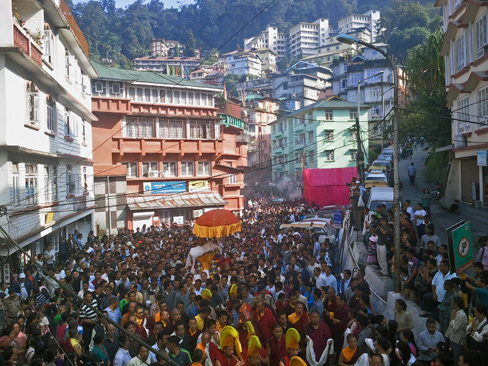
Auspicious signs and thousands of devout attend Lachen Rinpoche’s funeral


ANAND OBEROI ( Source:Sikkim Now)
GANGTOK, 26 Sep: The IVth Kyabji Lachen Gomchen Rinpoche was cremated here at Enchey Monastery with full State honours today. The kudung of the Lachen Rinpoche, who had passed away on 18 September at AIIMS hospital in New Delhi, was taken out of his residence at Development Area at 8 a.m. sharp and the funeral procession then walked up to the Enchey Monastery where the funeral was conducted between 10 and 11 a.m. 
Over 10,000 people from all walks of life joined the funeral procession which was also attended by Chief Minister Pawan Chamling who paid his last respects to the Rinpoche at Development Area itself. Also present were Speaker KT Gyaltsen, Rajya Sabha MP Hissey Lachungpa, Cabinet Ministers, MLAs, senior and retired government officials and former legislators and monk representatives from monasteries across the State.
The funeral procession walked it from Development Area through Zero Point, via TNA School and VIP Colony to reach Enchey Monastery where Lachung Rinpoche, Chorten Lachung Tulku, Tsulakhang Tulku and Jigmee Tulku from Ralang Monastery had prepared a magnificent mandala and an appropriate canopy for the cremation. Elaborate prayers were offered after which the Lachen Rinpoche was cremated.
People who had gathered in the thousands witnessed a series of auspicious signs, as are expected and hoped for when a religious leader of Lachen Rinpoche’s stature is cremated, as the funeral progressed. The was clear and sunny and a rainbow appeared as a halo around the Sun and held fast through the duration of the funeral and a collective sigh went up when an eagle, already a rare sight in Gangtok, started circling over the Enchey Monastery compound, directly over the funeral pyre the moment the fire was lit.
Both sign are considered highly auspicious by the devout who believe that these announce that the “passing-over has been clear”.
Monks from Ringhem, Phensang, Ralang, Tsuklakhang, Phodong, Pemayangtse Enchey, Lachen and Chorten Monasteries presided over the prayers.
Meanwhile, the ashes of Lachen Rinpoche will be taken to Lachen Monastery after three days for the people there to receive a darshan following which a Chorten will be constructed over some of the relics, the rest of the ashes then being taken for immersion in the Ganga, it is informed. It may be recalled that earlier it was planned to hold the funeral in Lachen, but owing to the series of landslides which have blocked the North Sikkim Highway which would have made transportation difficult and made it impossible for all his followers to attend the funeral, the cremation was held in Gangtok itself.
It may be mentioned here that the State government had declared a state holiday for today as a mark of respect for one of Sikkim’s most prominent Rinpoche’s and also to facilitate the general public to pay their last respects to the Rinpoche at his funeral.

Tuesday, 25 September 2012

Sahitya Akademi organises seminar on Tea Garden Literature


NEW DELHI, 24 Sept: Sahitya Akademi, New Delhi, organized a seminar on Tea Garden Literature here at the Rabindra Bhawan Hall yesterday.
A total of eight papers were presented at the seminar by Nepali language litterateurs. The speakers shed light on the uniqueness of Tea Garden Literature and its significance in the struggle for identity among the Indian Gorkhas. The speakers emphasized the need to continue this effort with deeper research and study on Tea Garden Literature.
In the inaugural session, Sahitya Akademi Secretary KS Rao informed that the Sahitya Akademi had organized the seminar in consultation with the Nepali Advisory Board and called this seminar, a first on the said theme, an important milestone.
82 years old Sahitya Akademi awardee, KS Moktan, delivered the keynote address and spoke extensively about Darjeeling tea and the well known writers and litterateurs from the tea gardens there. Mr. Moktan expressed that since the Dooars and Darjeeling tea gardens constitute an integral part where the identity of the people living there is concerned, the need for deliberation and discussion on this topic is equally important and relevant.
The Sahitya Akademi Nepali Advisory Board Convener Dr. Jiwan Namdung, speaking on the decision to conduct a seminar on Tea Garden Literature, said that Tea Garden Literature was the base of Indian Gorkhas and informed that this was the very first initiative towards its documentation and study.
The second session was chaired by Professor NB Rai from Shillong and had Dr. Rinji Eden Wangdi make a power-point presentation on the social life of the tea gardens. Representing Darjeeling, Prem Pradhan gave an overview to the historical aspect of tea gardens in relation to the social and literary developments.
Similarly, Yogbir Shakya, representing Kalimpong, spoke about the corpus of poetry which makes up Tea Garden Literature and also presented a reading of select poems.
The next session was chaired by Durga Prasad Shrestha and had eminent playwright and writer Laxman Shrimal speak works written on the tea gardens.
Similarly, in her deeply researched paper, research scholar Garima Rai spoke on the reflections of tea garden lifestyles in Nepali fiction that showed the role of Gorkhas in Darjeeling and Dooars and their contribution in the economic and cultural fronts of the country. Indra Sundas through her talk showed the important role played by women in the making of tea gardens.
The last session was chaired by the poet and writer Shanker Deo Dhakal. Emerging writer Terence Mukhia made a presentation on the present condition and mindset in the tea gardens, the opinion of youth in the modern times and highlighted the shortcomings of the managements.
Seventy year old folklore enthusiast, Dhanahang Subba, in turn, presented a paper on he historical basis of the story ‘Naya Sainli’ where he presented the relation between white Manager and the native labor woman. With reference to the journals published in the 60s, poet, writer and journalist Bijay Banatawa spoke about the exploitation and oppression of workers in the tea gardens and traced the rise of many poets like Agamsingh Giri after the Maragret’s Hope firing incident in the post independence phase and expressed the fact the problems and identity of the tea gardens have become the marker of national identity of Gorkhas.
In his observations as the chairperson of the session, Shanker Deo Dhakal said that the problems of the tea garden were problems of the nation and now the workers themselves should look for a solution with the formation of co-operatives and self management groups.
The Deputy Secretary of Sahitya Akademi J. Ponnudurai declared the publication of these papers in an edited volume with relevant additions in English within a period of six months. The sub-editor of Sahitya Akademi, Dr. Devendra Kumar Deves said that we should recognize the historical importance of this seminar since he had not come across any references to Tea Garden Literature in the world.
Source: Sikkim Now

Friday, 21 September 2012

A devotee offering milk to a snake during "Nag Panchami," celebrations at Shiva Temple in Jammu city in Jammu and Kashmir. During this festival some Hindus worship live snakes.  


Strdel/Agence France-Presse — Getty Images
A devotee offering milk to a snake during “Nag Panchami,” celebrations at Shiva Temple in Jammu city in Jammu and Kashmir. During this festival some Hindus worship live snakes.  

Tuesday, 18 September 2012


Last Indian village' embraces lost Tibetan link

By Raja Murthy

MANA, Uttarakhand, India - "I remember merchants from Tibet coming on horseback to Mana," 76-year-old Swajan Singh tells me as I walk up the mountain road from the revered Himalayan temple of Badrinath to Mana, near the Tibetan border. "It all changed after the 1962 India-China war."

Life has not changed much, though, for the crinkly-eyed Swajan. He looks like a Nepali sherpa (mountain guide), and like generations before him, earns a living tending to horses grazing in last of the pastures, amid the last of the vehicular roads in this part of India, at an altitude of about 3,500 meters.

Mana, 43 kilometers from the border and 540km north-northeast of the capital New Delhi, is the last civilian habitation before the closely guarded Himalayan regions where people are not officially permitted to stay the night.

Seven kilometers below Mana blooms the Valley of Flowers, an Indian Shangri-La believed to be a playground for celestial maidens after sunset. And so it may be. With the setting sun lighting up a bank of white clouds in a surreal glow, the mountains around Mana seem an unearthly paradise.

"Last village in India," proclaims the overhead governmental road sign as I reach the outskirts of Mana, 3km up the road from Badrinath. A historian might happily add: "The oldest living link to India-China trade."

The unique hamlet, perched above the mystical River Saraswati in the central Himalayas, is the ancient home to the last generation of the Bhotiya tribe, a semi-nomadic people of Indo-Tibetan ancestry.

The 300 Bhotiya families in Mana resemble time capsules retaining signs of centuries of trade through high mountain passes, decades of high-altitude agriculture and hand-spun woolen goods, with invading 21st-century changes of satellite TV, two nearby helipads and torrents of wonderstruck tourists.

An unexpected Nescafe vending machine and a Coca-Cola cooler symbolize such changes at the "Himalayan Cafe" inside Mana village.

"The last cafe in India," declares the signboard, with the cafeteria continuing its originality in the menu offering "chaumin" (which we hope is chow mein) and "Brad Bater" (maybe bread and butter).

Surendra, owner of the Himalayan Cafe, earns his bread largely from tourism, unlike his forefathers who had a career serving traders from Tibet.

Those traders who entered India through mountain passes now live only in memories of veteran inhabitants like old Swajan Singh. Mana itself is of uncertain age.

Just as the exact source of the Saraswati below Mana remains a mystery - the river vanishes underground soon after Mana and Badrinath - the date of birth of Mana is not known either.

The village, though, is closely linked with the ancient Indian epic Mahabharata. [1] Mana may be one of the oldest inhabited places on Earth.

"This cave is 5,111 years old as of 2003," says a painted sign above the entrance to the cave in Mana where sage Veda Vyas is said to have meditated.

But no official Archeology Survey of India sign confirms it, as one does outside the more than 2,000-year-old Kanheri Caves in Mumbai. In which case, the "5,111 years" may comfortably belong in the same boat as Noah's Ark.

The belief, though, is that Sage Vyas dictated the Mahabharata here in Mana to Ganesha, the hugely popular god of adventure and enterprise, in the nearby "Ganesh Cave".

The 11-day "Ganesh Chaturthi", starting on September 19 and celebrated across India, is the biggest annual festival in Mumbai, about 2,000km from Mana.

A tourist group appears from the southern state of Tamil Nadu, about 2,600km away, where too Ganesha is widely worshipped. Visitors plod through narrow paved pathways between old, low-roof dwellings, and keep the village economy alive buying local produce like woolen garments, apricots, and rare herbs.

Vehicles cannot enter Mana, not even bicycles. Time seems to stand still in some of these tiny cottages; dark-robed women sit outside spinning wool or stand to pound jhambu (Allium auriculatum), a rare herbal seasoning sold in small packets for 10 rupees (18 US cents). Raw jhambu tastes like dried grass, but it may be worth 10 times that humble price.

"Jhambu grows only for a few months far away, higher up in the mountain," explains Rekha, a more beautiful Indo-Tibetan version of the Bollywood star of the 1980s after whom she was probably named. "We collect only a handful of jhambu flowers after searching from morning to evening." It's very good for health, she says, and is the only seasoning Mana villagers use to spice their food.

Like Rekha, many Mana women and children have strong Mongoloid facial features and traditional Indian names. Rekha's three-year old son Ganesh, for instance, could easily be unnoticed among toddlers in any kindergarten in Lhasa, Tibet.

Rekha's husband Chandra Singh runs a tea shop adjacent to the Veda Vyas cave. "India's last tea stall," proclaims his 35-year-old establishment. And it brews a terrific frontier farewell with tulsi tea, regular milk tea made with basil (Ocimum tenuiflorum) leaves.

In the magical twilight of early evening, with a steaming cup of tulsi tea in hand, a breathtaking view of the world below and awe-inspiring Himalayan peaks around, heaven becomes a postal address on Earth.

But heaven is obviously not an easy place to reach, and Mana becomes proof of the essential choice in life: of taking the more difficult road to quiet and tranquility, or the easier beaten tracks filled with clamor and crowds.

August to early September, during rains and the threat of landslides, is generally considered an unwise time to take the road to Badrinath and Mana. So unconventional wisdom announces this is a good time to go - and take the risk.

On August 30, three landslides blocking the solitary route turned the usually 12-hour journey from Rishikesh to Badrinath into a 33-hour saga, including walking past and under a rockfall with the potential to ensure Asia Times Online has one fewer correspondent, taking four buses, an overnight halt in Karanprayag, and then a jeep ride from Joshimath town to reach Badrinath.

But it's worth even walking the distance; the deeply serene Himalayan neighborhood around India's last village reconfirmed that it inevitably pays to take the harder road.

Life in Mana too exchanges physical discomfort for the much greater mental comfort. When winter sets in, the entire population of Mana and Badrinath migrates about 45km down the mountain to Chamoli district, or to Joshimath.

Mana gets buried in snow sometimes 2.4 meters deep. A few solitary ascetics and soldiers then become the only dwellers around Mana.

Indian and Chinese army soldiers here share a more cordial frontier office space than their counterparts at the prickly border in India's northeastern state of Arunachal Pradesh.

"We having frequent border meetings with the Chinese army," an Indian Army major sporting a fierce mustache and a friendly grin tells me as I stop to chat with him, on my trek back from Mana to Badrinath. He is sitting with a walkie-talkie in hand by the roadside, watching his solders play volleyball in the adjacent meadow. "Many of the Chinese soldiers patrolling this border area happen to be women."

Indian and Chinese solders begin their border meetings with a friendly "Jhule," Tibetan for "Good day" and a common greeting among people in the high-altitude desert region of Ladakh, in the northern Indian state of Kashmir.

Indian Army officers posted here, says this major from Chandigarh city in Punjab, are required to learn Tibetan and Mandarin to ensure accurate communication in a sensitive border area.

With or without army presence, Mana could see further changes ahead. In the past two years, India and China have declared plans to revive these centuries-old bilateral trade routes through the Himalayas, such as through Nathu La and Shipki La passes.

Or, Mana may have other supra-mundane destinies in store, if an ancient legend comes true. The local belief is that some day in the near future, Badrinath will be entirely cut off from the rest of the world. And it won't be an unhappy prospect for those here, if and when that happens. Nothing quite like being stuck in a solitary heavenly abode, with a signboard saying "No way out."

Note
1. The Mahabharata, one of the two great Indian epics along with the Ramayana, narrates the lives of the five Pandava princes and their final war in Kurukshetra against their evil cousins the Kauravas. After winning the war, the Pandavas are believed to have passed through the Himalayas around Mana, on their way to heaven.

(Copyright 2012 Asia Times Online (Holdings) Ltd

Guinness World Record holder, pulling a “toytrain”

Sailendra Nath Roy, 49, a Guinness World Record holder, pulling a "toytrain" with his ponytail in Siliguri, West Bengal. Mr. Roy pulled the "toytrain" which weighed about 38,000 kilograms, two and a half meters with his ponytail.


Diptendu Dutta/Agence France-Presse — Getty Images

Sailendra Nath Roy, 49, a Guinness World Record holder, pulling a “toytrain” with his ponytail in Siliguri, West Bengal. Mr. Roy pulled the “toytrain” which weighed about 38,000 kilograms, two and a half meters with his ponytail.

India is concerned and committed to ensure sustainable management of its urban historic areas: Kumari Selja


The Culture & HUPA minister Kumari Selja has said India is concerned and committed to ensure sustainable management of its urban historic areas. Speaking at the Ministers meeting  AT 5TH ASEM MEET   “MANAGING HERITAGE CITIES FOR A SUSTAINABLE FUTURE” IN  YOGAKARTA, INDONESIA today she said, India recognises Quality of living of a city, satisfaction with cultural infrastructure such as concert halls, museums, libraries etc., satisfaction with public spaces including markets and pedestrian areas, satisfaction with public parks and gardens as well as beauty of streets and buildings and theattractiveness of cities towards tourists as important indicators to benchmark the governance of historic cities. She said approximately 30% of India’s one billion population lives in urban areas and the cities of India are growing at an unprecedented scale and speed. Urbanisation is taking place at an unparalleled speed throwing a challenge at the traditional historic cities. She said historic cities are yearning for a more inclusive and sustainable process of urban development.
 The Minister said, the draft National Conservation Policy envisages strengthening the role of crafts people whose knowledge of building materials and traditional systems in conservation works is indispensable. The emphasis here is on sustainable livelihoods as an integral part of sustainable development. She said New legislations of the Ministry of Culture AMASR Act 2010 [Ancient Monuments and Archaeological and Remains and Sites (Amendment and Validation) Act] provides for Heritage Byelaws to be prepared for every single monument of national importance. Kumari Selja Said her country has been instrumental in supporting the preparation of the UNESCO/UN-HABITAT Toolkit on ‘Historic Districts for All – India: A Social and Human Approach for Sustainable Revitalisation’, comprising of a Manual for City Professionals. This is a powerful instrument for raising awareness and building capacity for the Urban Local Bodies and our State Governments to design and implement policies and programmes for the present and future inhabitants of city cores.

            She said ,An apex body – The National Monuments Authority has been set up with the aim of  introducing  new ways of sensitive planning, using tools such as ground surveys and  ‘Cultural Impact Assessment’ to ensure that  mega infrastructure and other developmental projects  do not harm the historic environment. The authority is also equipped with enforcement powers and can impose stringent penalties for violations in heritage landscape. This applies equally to private citizens and government functionaries who allow such violations to take place.

 The minister said that the Ministry of Urban Development (MoUD), Government of India and UNESCO, New Delhi Office have developed a partnership “Moving towards Heritage based urban development” to help safeguard and promote the sustainable use of India’s unique and diverse urban heritage. The project primarily aims to mainstream the concern for heritage protection and conservation, and the sustainable use of cultural and natural resources, in our ambitious Urban Development Mission viz. Jawaharlal Nehru National Urban Renewal Mission (JNNURM). The objective of this Mission is the creation of economically vibrant and productive Indian heritage cities. She said the joint UNESCO-MoUD project positions heritage as important and central to urban development initiatives.  The Minister said the Indian Heritage Cities Network (IHCN)  comprising of  22 Indian heritage cities, seven French cities  and several regional and non-governmental partners, along with UNESCO, helped revise the ‘JNNURM Draft Toolkit for the Preparation of  City Development Plan’ with a special focus on heritage concerns. 

            Kumari Selja said we have exemplary examples of urban renewal projects within historic cities such as the urban renewal initiative between ASI and AKTC (Aga Khan Trust for Culture) in Nizammudin area. Historic cores in cities of Mumbai, Delhi, Varanasi, Hyderabad,Madurai, Mysore, Jaipur, Udaipur and many more have taken initiatives in framing heritage management plans and heritage committees for conservation and development of historic areas.
***


AD                                                                     

(Release ID :87827)

Coimbatore, September 17, 2012

The tribal way of life

Subha j rao

  • A Feeling of Community: Toda women dancing during a function Photo: PTI
    PTI A Feeling of Community: Toda women dancing during a function Photo: PTI
  • C. Maheswaran, director, Tribal Research Centre, Ooty
    C. Maheswaran, director, Tribal Research Centre, Ooty
C. Maheswaran threw the spotlight on the evolved traditions and customs of tribals
A Kaadar boy living in the Anamalais sits in a corner with some bamboo and gets to work. He smoothens the reed, creates sharp teeth and polishes it to a shine. Then, he carves out elaborate designs — a comb. It is for his beloved. If she accepts the comb, she becomes his.
When the Malayaalis go looking for a prospective bride, they swirl a stick in the air to let people know they are coming. If the prospective bride’s people take the stick inside their home, it means the proposal is welcome. If the stick is thrown back, the bridegroom’s party returns without protest.
This is how tribals communicate. Without many words being spoken, said C. Maheswaran, director, Tribal Research Centre, Ooty. He recently delivered a talk on ‘Lifestyles of Kongunadu Tribes’, as part of the monthly lecture organised by The Vanavarayar Foundation.
Tribes have influenced the lifestyle of Kongunadu in many ways, he said. Why, even our city is named after an Irula tribal chieftan, Kovan!
While some tribes have learnt to move on with time, others have held fast to a vanishing way of life, he said. Which is why, even today, some tribes follow the ancient practice of ‘kalavu vazhkai’ (living together out of wedlock) before ‘karpu vazhkai’ (marriage). And, also why when a Toda woman gets pregnant, her husband takes her a small gift made of shrub and grass blades, shaped like a traditional Toda house. With this, he announces that the child is his and will be born into his clan.
Actions speak
Maheswaran spoke about how tribals have adopted a refined communication technique, one that relies less on words and more on action. This has prevented wordy duels and arguments. For instance, when going to seek a boy’s hand, the elders would say: “We have some seeds, can you give us the land to sow it in?” If all went well, a stick (representing the boy) would be left in front of the girl’s house, letting everyone know she has been spoken for.
Though many tribes live a hand-to-mouth existence, they have not forgotten about graceful community living. For example, the Pazhiyar have to dig deep into the hard ground for edible tubers. It may take a man well over half a day to find the tuber, but once he does, he will snap off only one bit, and leave the rest for others. En route to the digging site, if he saw a honeycomb, he would mark it with a cross, as if booking it. If another man came to the forest to extract honey and found nothing, he would still not go near the marked honeycomb. “That’s the kind of grace they exhibit,” said Maheswaran.
Most traditions have survived because of oral narratives, said the expert on tribes. And, the feeling of community is very strong. “Every occasion, be it building a temple, a wedding or a funeral, sees them get together. And, when it comes to training adolescents, the old tribals — men and woman — ease them into the ways of their world.”
The welfare of each tribe is paramount to its members. Which is why, among the Aalu Kurumbas, once a year, seven people go out into the forest, for seven days, without informing anyone. They live off the jungle, in a bid to call upon Nature to protect their village. When they return, they cook pongal in seven pots and feed everyone — a case of the individuals working for social good, pointed out Maheswaran.
TRIBES TALK
Kongunadu is home to 14 of the36 tribes in Tamil Nadu. All the six Particularly Vulnerable Tribal Groups in Tamil Nadu — Toda, Kota, Kurumba, Irula, Paniya and Kadunaickaya — are in the Nilgiris.
The Maha Malasar or Mala Malasar in Valparai can converse with elephants. They work as mahouts.
Kurumbas are known for their painting and black magic; Todas for their embroidery; Kotas for their pottery and carpentry; and Kadunaickayas for their expertise in honey collection. 

Monday, 17 September 2012

Indian tank brigades to defend China border


Ajai Shukla / New Delhi Sep 17, 2012, 00:49 IST
Business Standard


The army’s defences on the China border will get a major offensive boost with the impending deployment of two tank brigades, one each in Ladakh and north-east India. This is the first time that India will deploy armoured formations on the China border. Such formations, equipped with main battle tanks and BMP-II infantry combat vehicles, are traditionally used for striking into enemy territory.
Authoritative MoD (Ministry of Defence) sources tell Business Standard that the plan, cleared by the MoD, involves raising six new armoured regiments, equipped with 348 tanks (58 tanks per regiment, including reserves). In addition, three mechanised infantry battalions will be raised, amounting to about 180 BMP-IIs.
The decision to deploy tanks to beef up India’s light, mountain infantry divisions was taken due to doctrinal changes in China’s People’s Liberation Army (PLA). The PLA has deployed armoured and motorised formations in both their military regions across the Line of Actual Control, as the de facto Sino-Indian border is called. According to the International Institute of Strategic Studies, Lanzhou Military Region, which faces Ladakh, has 220,000 PLA troops, including an armoured division and two motorised infantry divisions (a division has three brigades). The Chengdu Military Region, opposite India’s north-eastern states, has some 180,000 PLA troops, including two armoured brigades and four motorised infantry divisions.
The Ladakh-based 14 Corps will be allocated an armoured brigade to cover the flat approaches from Tibet towards India’s crucial defences at Chushul. In the Sino-Indian war of 1962, six vintage AMX-13 tanks that the Indian Army had airlifted to Chushul inflicted serious losses and delay on the advancing Chinese.
The second armoured brigade will be located in the Siliguri corridor in Bengal, covering the approaches from Sikkim to the plains. One regiment will be located on the flat, 17,000-feet-high North Sikkim plateau, on which border areas are hotly disputed between China and India.
According to MoD sources, the army has demanded the purchase of additional T-90 tanks for these six armoured regiments. India has already bought 657 T-90S tanks from Russia and obtained a licence to build another 1,000. Now, in addition to these purchases, the army wants the latest version of this tank, called the T-90MS.
Contacted for comments, the army has not responded.
As first reported in Business Standard, India is also raising a mountain strike corps in the northeast, consisting of two mountain divisions with about 40,000 soldiers. The addition of an armoured brigade would add real teeth to the strike corps.
The army demanded such capability because China’s infrastructure build-up in Tibet allows it to rapidly concentrate forces in a sector, overwhelming the Indian defenders there. If China manages to capture a chunk of territory, India will no longer be forced into bloody, Kargil-style, counter-attacks to recapture it. Instead, an Indian strike corps could launch an offensive in an area of its choosing, capturing Chinese territory.
The north-east has already seen a vastly strengthened Indian Air Force (IAF). Sukhoi-30MKI fighters are flying from new IAF air bases in Tezpur and Chhabua, with additional air bases coming up in Jorhat, Guwahati, Mohanbari, Bagdogra and Hashimara. Six squadrons of the anti-aircraft Akash missile will defend north-eastern airspace. The IAF is modernising eight Advanced Landing Grounds, which would support offensive operations in the sector.

Trekking in Sikkim: The Top 4 Destinations for Trekking


Sikkim is a well-known state on the map of India and the world for the richness of the natural bounties and its extravagant show. Landlocked by Nepal, Tibet, West Bengal and Bhutan, it is the second smallest state after Goa and just as richly bestowed for tourists’ devouring looks. The landscapes of this state allow trekkers to find their way in and out through the difficult routes of hilly terrains and still enjoy everything encountered.

Trying any of the popular trekking destinations in Sikkim is worth of the time in the Himalayas:
Trekking in Sikkim
Yuksom Dzongri Trek
Delhi is the destination generally to start for the trip to Sikkim to get on the trekking between Yuksom to Dzongri. The only place that is in the route is Tshoka. Else, coming to Bagdogra followed by Darjeeling is the way to reach Yuksom to start the trekking journey. The trip could be extended to Goecha La if wished and generally the trekking itineraries will describe it full-fledged. Choose what you specifically want. The whole trip will consume around 6 days’ time. Panoramic sceneries of Kabru, Ratong, Kanchenjunga, Koktang, Pandim and Narsingh will be the gift of sight you will carry in your memories.
Singalila Trek
The trek could be tagged somewhat similar to the one explained above if trekker is planning for a long trip and not just stopping at ridge Singalila. But this is not the case here. From Darjeeling, the trekker will take the route of Maneybhanjang, Tonglu, Garibas to Singalila Ridge. If the journey is continued it will lead to Sandakphu which a good place to try hands on camera.
Darjeeling Kanchenjunga Trek
A trip of around a quarter of month or may be more, it is meant for trekkers who have seen the roughness of mountains and know its villainous ways. Reach Darjeeling via Bagdogra from Delhi. The actual trekking will start from Uttarey covering Chewabhanjang, Dhor, Paharey Megu, Daphe Pass, Gomathang, Panding, Dzongri, Thangsing, Samity Lake, Goecha La, Lam Pokhari, Kasturi La, Kasturi Odar, Labdang and Tashiding. Near Goecha La, you will get the spectacular views of Mt. Kanchenjunga here while enjoying trekking in Sikkim Himalaya.
 Green Lake Trek
The base camp of Mount Kanchenjunga is reached by taking the journey on this trek. The Zemu Glacier makes the view very appealing. The mountain flowers infuse the route with veritable colors and can anytime make a normal traveller turn in to a prolific photographer. Getting acclimatize to the climate makes sense else mountain sickness can pull the trekker down from the terrific journey. The places on the trek will be Lachen, Jakthang, Yabuk, Siniolchu and Green Lake. The view of Kanchenjunga in the Lake is just fabulous. Consider coming here when trekking in Sikkim.
 Be assured that lovers of trekking are going to have a blast here!

Read more at http://www.business2community.com/travel-leisure/trekking-in-sikkimthe-top-4-destinations-for-trekking-0281183#5lYRyU2IJHYE7tfm.99